
Every new year comes with the same momentum: a time for good resolutions. January is that special moment when we step back, review the past year, and start asking new questions. A desire to learn. A desire to grow. A desire to change something — sometimes without yet knowing exactly what.
For many people, 2026 is shaping up to be a pivotal year. A year to strengthen a professional project, consider a career change, build new skills, or simply reconnect with the pleasure of learning and progressing. In this context, one question naturally arises: what if one of your best resolutions for 2026 was to invest in yourself?
Training is not just about acquiring knowledge.
It is also about opening up to new worlds, meeting new people, structuring your thinking, building confidence, and sometimes even reshaping your professional path.
This is exactly the spirit behind the short, certified courses of the Wine & Spirit Education Trust (WSET). Far more than just a diploma or another line on a CV, WSET is at once an experience, a framework, a cultural opening and a practical lever. It is a complete ecosystem where you learn to understand wine, spirits, sake and beer — but also to better understand yourself: how you learn, how you taste, and how you progress.
In 2026, starting a WSET course can therefore become much more than good resolutions or an academic goal: a genuine personal and professional project — useful, structured and long-lasting.
1. A training course… but not just that
When people talk about wine, spirits, sake or beer training, or about a WSET course, many still imagine a fairly traditional format: classes, a textbook, and an exam at the end. A school-like, almost academic approach, where the main objective would be to accumulate knowledge and reproduce it on exam day.
The reality is quite different.
WSET is not designed as a simple transfer of knowledge, but as a method to learn how to taste and understand wine, spirits, sake and beer. You do not just learn what a wine or a spirit is — you learn, above all, why it has this style, this structure, this balance.
Throughout the course, you develop:
- a new way of tasting, more precise, more structured and more conscious,
- a real analytical ability to understand what is in the glass, beyond a simple “I like / I don’t like”,
- and a structured and coherent beverage culture, which allows you to connect regions, climates, production methods and styles.
In practical terms, training with WSET means learning how to:
- observe a wine or a spirit in a methodical way,
- analyse its structure, aromas and balance,
- reason in terms of cause and effect (climate, grape variety, distillation, ageing, fermentation, etc.),
- and clearly explain what you are tasting, both to yourself and to others.
This is why WSET goes far beyond a traditional training course. It is not about piling up information, but about creating a real change in perspective. You never quite drink in the same way again once you have learned how to taste, understand and interpret.
Training with WSET is therefore not just about “learning wine” or “learning spirits”. It is about learning how to understand — and that skill, once acquired, stays with you for a lifetime.

2. Taking on a personal challenge (and growing from it)
Committing to a WSET course is not just about good resolutions.
It is also — and very often above all — taking on a personal challenge. For many people, this means going back to studying after several years, getting back into a learning mindset, and rediscovering habits of concentration, memorisation and personal work that they sometimes thought they had left behind.
This decision is never trivial. It means:
- setting a clear and measurable goal,
- accepting to step out of your comfort zone,
- and facing a demanding but highly structuring framework.
As the course progresses, something almost always happens: you start to regain confidence in your ability to understand, memorise, reason and improve. Concepts that once seemed complex become clearer. The connections between regions, styles and production techniques start to make sense. And above all, you realise that you are capable of learning far more than you had imagined.
The exam, often seen as a source of stress at first, then becomes a starting point: not just an academic test, but the culmination of a personal journey and the beginning of many new discoveries. Going all the way, succeeding, validating an internationally recognised level — all of this brings a very special sense of achievement. The satisfaction of having kept a commitment. The satisfaction of having proven something to yourself.
In this perspective, WSET goes far beyond the scope of a technical training course. It becomes a structuring and empowering challenge, one that builds self-confidence, rekindles the pleasure of learning, and creates a positive dynamic well beyond the world of wine and spirits.
👉 You can discover our courses,
👉 learn more about the different programmes and funding options,
👉 or simply get in touch with us at [email protected]
3. Building a true general culture of wine, spirits, sake and beer
Training with WSET is not just about learning to recognise aromas or memorising appellations.
It is about building a true general culture around wine, spirits, sake and beer — a culture that is rich, structured and long-lasting.
Because behind every glass, there is much more than just a beverage. There is:
- geography, with regions, landscapes, and maritime or continental influences,
- climate, which shapes styles, balance and levels of ripeness,
- agriculture and biology, with their principles, choices, constraints, practices and evolutions,
- history, made of traditions, crises, innovations and transmission,
- economics, which explains prices, markets, and the logic of production and distribution,
- and of course gastronomy and the art of living, because these drinks are, above all, meant to be shared at the table.
This approach creates a culture that is useful, because it helps you better understand what you consume and what you buy. Transversal, because it connects very different disciplines and worlds. And valuable, both socially and professionally, because it allows you to speak clearly and accurately about a subject that runs through many moments of life.
In practical terms, this changes many things. You learn how to:
- explain what you are drinking, using precise and accessible words,
- choose better, whether at a wine shop, in a restaurant or from a wine list,
- understand the logic behind selections, proposed styles and price positioning.
This kind of culture does not become obsolete. It does not depend on fashion or trends. It is a lasting culture, one that accompanies you throughout a lifetime as a taster, an informed enthusiast or a professional — and that deeply transforms the relationship you have with wine and other beverages.

4. A human and social experience, beyond your good resolutions
We often forget this, but a training course is never just about educational content. It is also — and sometimes above all — a human experience. And in this respect, WSET courses often hold some very pleasant surprises.
In a single session, you will typically find a wide variety of profiles:
- people in the middle of a career change,
- professionals from wine, hospitality or retail,
- enthusiasts looking to structure their knowledge,
- entrepreneurs seeking credibility and a broader vision,
- students preparing their future.
This diversity creates a very special dynamic. Very quickly, something happens: exchanges, discussions, mutual support. You compare your tasting perceptions, share field experience, challenge each other’s projects. And, almost naturally, a network starts to form.
Here, the role of the place and the learning environment is essential.
At Weeno, we have deliberately chosen to create a space that is both friendly and demanding: an environment where you can work seriously without ever losing the pleasure of learning together. Tastings become moments of dialogue. Breaks become opportunities to connect. And some of these encounters turn out, over time, to be unexpected but extremely valuable: collaborations, professional opportunities, shared projects, or simply long-lasting friendships.
And this human dimension is not limited to in-person courses.
Even online, WSET training relies on an interactive platform where you can exchange with your entire virtual class, share questions, reflections and progress. The “online classroom” also becomes a real space for collective life and learning.
In this sense, WSET is much more than a training course.
It is a social and relational space, a place for meeting people and building connections, where you learn as much from others as from the content itself. Not just a classroom, but a community in motion.
5. A real professional lever (even when you don’t know it yet)
Many people enrol in a WSET course without having a perfectly defined professional project. Out of curiosity. Out of a desire to learn. Out of a need to structure their knowledge. And yet, in a very large number of cases, WSET becomes — sometimes without having been planned — a true lever for professional transformation.
There are many concrete examples:
- career changes towards wine, spirits or gastronomy,
- internal career progression in companies where beverage expertise becomes a strategic asset,
- a significant gain in credibility with clients, partners or recruiters,
- a new legitimacy to speak, advise, sell or teach.
What WSET brings is very specific. First, an international common language. Wherever you are in the world, WSET levels, methods and vocabulary are recognised and understood. Then, clear recognition, backed by an independent and respected institution. Finally, a strong signal on a CV: that of a demanding, structured training programme focused on understanding rather than memorisation.
But the impact often goes even further. Even when you start without a precise goal, something begins to move. Doors open. Ideas emerge. Discussions during the course lead to new leads, contacts and projects. Some people discover a profession they had never considered. Others finally find the framework they were missing to professionalise a passion.
In this sense, WSET acts as an accelerator. Not only of skills, but of trajectories. It does not guarantee a specific career path — no training programme can — but it creates a fertile, structured and credible ground on which opportunities are far more likely to emerge.
👉 You can discover our courses to start turning your good resolutions into action,
👉 learn more about the different programmes and funding options,
👉 or simply get in touch with us at [email protected]

6. Training smart: the key role of funding
When considering a training course, one question almost always comes up: the budget. And very often, this is where many projects stop before they even begin. Yet, in the case of WSET, one reality is still largely unknown: these courses can be funded — sometimes almost entirely.
Personal training accounts (such as the French Compte Personnel de Formation), company funding schemes, employment and career-transition programmes, professional retraining plans, or other support mechanisms depending on your situation… For many learners, the actual personal investment is far lower than they initially imagine. And that changes everything.
Because the cost–benefit ratio then becomes particularly compelling:
- a limited financial investment,
- for a very high return in terms of skills,
- general culture,
- professional network,
- and credibility.
Very few training programmes offer such a high level of added value on so many levels at once.
This is also what makes the decision especially relevant in the context of good resolutions. We are not talking here about an impulsive expense, but about a structured, thoughtful, useful and long-term investment — made possible by funding schemes specifically designed to support professional development and upskilling.
It could be summed up in a simple phrase: a useful luxury made accessible.
A high-level training programme, internationally recognised, demanding in content — yet whose access is made easier thanks to existing funding mechanisms.
In other words, 2026 can be the year you stop postponing an ambitious training project, not because it is too expensive, but because it is finally smart, rational and truly possible to make it happen.

7. Why 2026 is an excellent year to get started
There is something special about the beginning of a new year and its good resolutions.
A momentum. A time when decisions are easier to make, when we are more willing to question certain things, and when we allow ourselves to project into the future.
2026 is no exception.
It is naturally a good time to:
- reposition yourself,
- restart or refocus,
- structure a project that until now may have remained just an idea or an intuition.
Many professional paths do not change by chance. They change because, at some point, a decision is made: the decision to invest in your skills, your understanding and your credibility.
We all know the trap: “I’ll do it later.”
Later often means next year. Then the year after. Then never.
Not because of a lack of desire, but because everyday life takes over and the initial momentum fades.
Yet the reality is simple and widely observable: people who truly change their trajectory almost always start with a training course. Not necessarily because they know exactly where they are going, but because they create the conditions for something new to become possible.
Getting started in 2026 is not just about adding another line to your CV.
It is about starting a movement. Giving direction. Opening up a field of possibilities. And very often, discovering along the way opportunities you would never have imagined otherwise.
8. The Weeno approach: learning seriously, without taking ourselves too seriously
Behind any demanding training programme, there is always a question of method… but also of framework. At Weeno, we are convinced that you can learn seriously, in depth and with rigour — without ever losing the pleasure of learning.
Our teaching approach is built on a few simple and consistent principles:
- a clear and readable approach, which does not drown learners in unnecessary jargon,
- a progressive and coherent structure, allowing knowledge to be built step by step,
- a real demanding standard in content, but always human and supportive in form.
Tasting plays a central role in this approach. Not as a simple “pleasant moment”, but as a true educational tool. You learn by tasting, comparing, describing, sometimes making mistakes, and refining your benchmarks. Understanding never remains theoretical: it always goes through direct experience.
But the Weeno experience is not just about content or method.
It is also about the place, the team, the atmosphere and the quality of the support. Whether in person or online, everything is designed to create an environment that is both serious and welcoming, structured and stimulating — a place where you feel legitimate to learn, to ask questions and to progress at your own pace.
It is this combination of rigour, pedagogy, tasting and human connection that makes the Weeno approach unique. A way of approaching WSET not as just another certification to obtain — or just another good resolution to tick off — but as a complete and long-lasting learning experience.
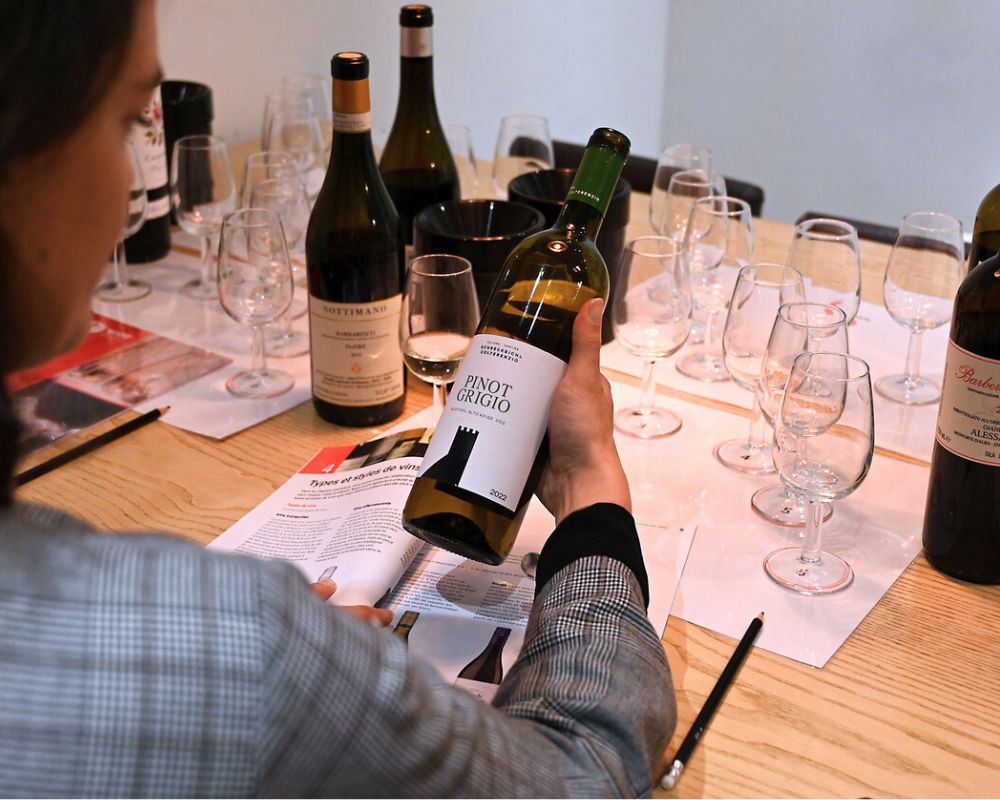
Training with WSET is not simply about adding one more qualification to your career.
Nor is it just about learning regions, grape varieties or production techniques. It is a complete experience. A turning point. An investment in yourself.
Throughout the courses, you of course acquire solid, internationally recognised knowledge. But you also gain method, confidence, general culture and a network. You change the way you taste, the way you understand, the way you choose. And very often, you also change — sometimes subtly, sometimes deeply — your personal or professional trajectory.
There are many good resolutions.
But the ones that really matter are those that create lasting change.
Good resolutions are the ones that truly make a difference.
If the idea of better understanding wine, spirits, sake and beer appeals to you…
If you feel that 2026 could be the year to structure a project, restart a new dynamic or simply invest intelligently in yourself, then WSET might be an excellent place to start.
👉 You can discover our training programmes,
👉 learn more about the different learning paths and funding options,
👉 or simply get in touch with us at [email protected]
Sometimes, one conversation is all it takes to start a new project.