

WSET: a global benchmark in alcoholic drinks education
In the world of wine, spirits, sake and beer, few acronyms appear as often as WSET. The Wine & Spirit Education Trust is an international awarding body specialising in alcoholic drinks education. It develops qualifications, ensures their quality, and relies on a global network of approved course providers to deliver them. Today, WSET qualifications are offered in more than 70 countries, in 15 languages, through more than 900 partner providers.
If the WSET name appears so frequently across wine and spirits careers, it is because it has become a true industry benchmark. Its role is not simply to offer courses, but to establish a shared professional language, analytical methods and progression levels recognised across the sector. WSET itself defines its mission as helping people progress through inspiring learning experiences, all over the world.
In other words, referring to a WSET diploma or a recognised certification is not just about brand recognition. It refers to a training framework built on clearly defined standards, with qualifications created and quality-controlled by a recognised awarding organisation, and with an impact that is visible both for professionals and for serious enthusiasts.
In this article, we answer several essential questions in a clear way: Who is the WSET? What is the real value of WSET certification? What are the different levels for? And why has this training become a global reference in drinks education?
1. Who is the WSET? History, mission and current positioning
The Wine & Spirit Education Trust (WSET) was founded in 1969 in the United Kingdom as a charitable trust. At the time, its creation responded to a very practical need: to structure and professionalise education for the British wine and spirits trade. The initial objective was clear: to provide a strong educational framework for a sector undergoing rapid change, with qualifications that were both clear and recognised.
Over the decades, the WSET has significantly expanded its scope. From an organisation historically focused on wine and spirits, it has become a global player in drinks qualifications, with certifications that now cover not only wines and spirits, but also sake and beer. This evolution reflects a broader transformation within the industry itself: drinks expertise has become increasingly cross-category, international and structured.
The WSET’s current positioning fully reflects this shift. Its official mission is to “empower people through inspiring learning experiences, all over the world.”
In other words, its purpose is no longer limited to transmitting technical knowledge. It is about enabling each learner — whether a professional, a demanding enthusiast or someone considering a career change — to progress through inspiring educational pathways recognised on a global scale.
This repositioning is accompanied by an evolution in both discourse and image: the WSET increasingly affirms its role as a global drinks education expert, serving an international community of learners and professionals. It is precisely this dual dimension — a strong historical legacy combined with an ability to adapt to new market expectations — that explains why the WSET now occupies such a central place in drinks education.
2. The WSET’s new brand strategy: towards global, emotional and accessible drinks education
The Wine & Spirit Education Trust is now entering a major strategic evolution, marked by a clear desire to position itself within a broader Global Drinks Education movement. This new direction goes beyond the organisation’s historic focus on wine and spirits and fully embraces a multi-category approach, now encompassing four worlds: wine, spirits, beer and sake.
At the heart of this transformation is a clear objective: to expand its international reach, accelerate its digital transformation and strengthen engagement with enthusiasts around the world. The WSET also seeks to demonstrate a strong commitment to accessibility, making its programmes more inclusive, flexible and open to an increasingly diverse range of learners.
This new strategy is embodied in a strong signature — “The Language of Taste” — which reflects a renewed ambition: to make taste a universal language, capable of creating connection, sparking emotion and linking cultures. The brand repositioning, accompanied by a new logo, reflects this desire for modernity and openness.
But beyond expansion and structure, the WSET is making a more subtle and profound shift: toward emotion. Learning is no longer limited to acquiring technical knowledge; it becomes a sensory and immersive experience. The goal is now to foster an emotional connection with learners, inviting them not only to understand, but also to feel.
This approach is built on four fundamental pillars that shape the educational experience:
- The classroom atmosphere, designed as a lively, interactive and inspiring space where exchange and conviviality support learning.
- Terroir and the producers’ vision, which place each product back into its origin, history and intention.
- Production methods, allowing learners to understand technical decisions and their impact on sensory profile.
- The final product, approached not only through analytical tasting, but also through the emotions it can evoke.
Through this new strategy, the WSET aims to awaken curiosity, deepen understanding and, above all, place greater emphasis on personal perception and experience. The goal is no longer simply to know how to describe a wine, beer, sake or spirit, but to be able to speak about it as an experience, a story and a moment.
This evolution marks an important stage in the WSET’s history: that of an institution which, while preserving its academic rigour, chooses to fully embrace a more human, more sensory and more deeply contemporary approach to drinks education.

3. What does the WSET actually do?
To properly understand what a WSET certification is, it is first necessary to distinguish between two levels of responsibility. The WSET is not a school in the traditional sense: it is an awarding organisation, comparable to an exam board. In practical terms, it is the body that designs the qualifications, defines the standards, develops the examinations, oversees marking and guarantees the quality of the entire system.
The courses themselves, however, are generally not delivered directly by the WSET. They are offered through a global network of Approved Programme Providers (APPs) — in other words, centres accredited by the WSET, such as Weeno. These providers are authorised to teach WSET programmes, but they must do so in strict compliance with the educational, administrative and quality standards set by the awarding body.
The distinction is therefore essential:
- the WSET = the awarding organisation that creates, oversees and guarantees the value of the qualifications;
- approved schools = the organisations that actually deliver the training to learners.
This structure provides reassurance on several levels. First, it guarantees international consistency: a WSET diploma is based on the same standards, regardless of the country or training provider. Second, it offers real clarity for employers and industry professionals, who know that a WSET qualification corresponds to a common and recognised benchmark. Finally, it reinforces the credibility of the qualification, since its content, assessment and quality do not depend on a single centre, but on an independent and recognised organisation.
It is precisely this model that makes the WSET a reference point: training delivered locally, but certification designed, controlled and recognised globally.
4. What is WSET certification?
A WSET certification does not simply confirm that someone has attended a course. It validates a progressive set of competencies, built according to precise standards and assessed within a recognised framework. Depending on the level completed, a WSET qualification typically certifies:
- technical knowledge of wines, spirits, sake or beer;
- the ability to taste in a structured way, using a clear analytical method;
- an understanding of styles, their origins and the factors that influence them;
- the acquisition of a shared professional language used across the drinks industry.
This combination is precisely why WSET certification is so often regarded as a recognised qualification. It is not based on an intuitive or purely descriptive approach, but on a progressive educational framework that teaches learners how to observe, compare, analyse and explain. The diploma therefore becomes a clear and readable reference point for professionals, recruiters and market stakeholders.
Today, WSET qualifications are offered in more than 70 countries through a global network of approved providers, giving them particularly strong international reach. This worldwide presence strengthens the clarity and consistency of the qualification: a WSET level obtained in Paris, Marseille, London or Singapore refers to the same standards.
In other words, WSET certification is not “just a course.” It is a standardised progression framework, recognised by the industry, that helps people structure their skills over time and clearly position their level within the world of drinks. That is also what makes it, for many, a genuine tool for professional development and credibility.

5. What are the different WSET levels?
WSET qualifications are designed as a structured progression, with levels that correspond to different needs, learner profiles and objectives. In wine, the most commonly followed qualifications are Levels 1, 2 and 3, each with its own degree of depth and difficulty.
WSET Level 1
WSET Level 1 is an introductory qualification. It is designed for people who are new to the world of wine or who want to build solid foundations in a structured way. The course covers the main types and styles of wine, key grape varieties, the basics of wine service and a few simple food and wine pairing principles. It is an excellent entry point for beginners or for those who want to turn curiosity into organised knowledge.
WSET Level 2
WSET Level 2 is an intermediate qualification. It goes further in explaining wine styles, key regions and the main production methods. Learners are introduced to a broader range of grape varieties, producing countries and the factors that influence how wine tastes. This level is suitable both for committed enthusiasts and for professionals at an early stage in their career. It often represents the first real step toward a more analytical understanding of wine.
WSET Level 3
WSET Level 3 is an advanced qualification. At this stage, the goal is no longer simply to recognise or memorise, but to reason analytically. The programme develops a detailed understanding of viticulture, winemaking, maturation and how these factors influence the style and quality of wines. Tasting is also more demanding, with a structured analytical approach based on the WSET Systematic Approach to Tasting (SAT). This is the benchmark level for wine professionals and highly committed enthusiasts who want to deepen their expertise seriously.
Who Is Each Level For?
In simple terms:
- Level 1 is suitable for beginners;
- Level 2 is aimed at those who want to consolidate and broaden their knowledge;
- Level 3 is for those who want to develop an advanced, more professional understanding of wine.
Do You Have to Take the Levels in Order?
WSET generally recommends completing the previous level — or having an equivalent level of knowledge — before moving on to the next one. In particular, Level 3 strongly recommends that learners hold Level 2 or can demonstrate an equivalent level of knowledge. This is not just an administrative rule, but a matter of educational logic: each level prepares the ground for the next.
Overall, the different WSET levels make it possible to build a progressive, readable and internationally recognised learning path, whether you are a curious enthusiast, a working professional or someone considering a career change.
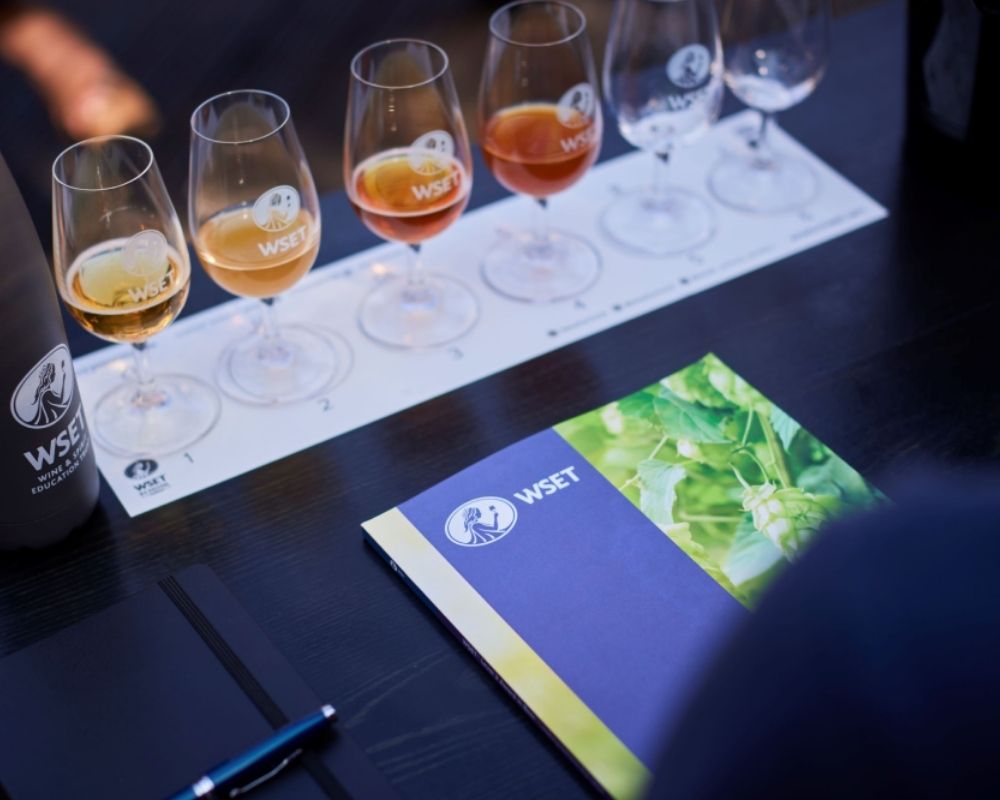
6. WSET in wines, spirits, sake and beer: which specialisations?
WSET is not limited to wine. Today, its qualification portfolio covers four major specialisations: wines, spirits, sake and beer. This is precisely what explains its current positioning as a global actor in drinks education, rather than solely as a historic wine and spirits organisation.
In practical terms, this means that a learner can build a coherent pathway based on their own project and ambitions. Someone wishing to deepen their wine knowledge will naturally turn to WSET wine qualifications, while a professional working in bars, retail or distribution may choose to specialise in spirits. Enthusiasts or professionals interested in Japan can focus on sake, and those who want to structure their understanding of brewing and tasting can follow the beer pathway. WSET presents these qualification families as distinct yet complementary, each with its own progression levels.
At Weeno, this logic of specialisation makes complete sense. We offer WSET courses that allow each learner to adapt their pathway according to their profile and objective: personal passion, career change, upskilling or deeper specialisation within a specific drinks category. This modularity is one of the great strengths of the WSET system: it is not a rigid curriculum, but a structured progression framework that can be adjusted to fit personal or professional goals.
This is also what makes the WSET model so effective. It allows learners to build drinks knowledge in a progressive and readable way, according to different logics:
- cultural, to better understand what they taste;
- professional, to strengthen their credibility on the market;
- strategic, to orient or reorient a career path;
- or specialist, when the goal is to deepen expertise in a specific category.
In other words, choosing a WSET wine course or a WSET spirits course is not just about selecting a subject. It is about choosing an angle of expertise that is aligned with a personal or professional project, within a framework recognised internationally.

7. Why is the WSET diploma recognised — and what career opportunities can it open up?
The WSET diploma is recognised in the market for one simple reason: it provides a clear, structured and internationally readable measure of competence. In a sector where career paths can vary greatly, that kind of clarity matters. WSET helps learners acquire a shared professional language, a structured tasting method and an analytical understanding of wine, spirits, sake and beer styles. For a recruiter, employer, client or business partner, this qualification sends a very specific message: the holder has completed a serious, recognised and well-framed training programme.
This is also why it carries weight on a CV. The value of WSET does not rest solely on brand recognition, but on its real pedagogical value: international standards, progression through clearly defined levels, a rigorous analytical method and structured assessment. In other words, it is not just a well-known name, but a training framework that helps position a candidate’s level in a concrete and credible way.
From a professional perspective, the opportunities are wide-ranging. A WSET qualification can strengthen a career path in many different roles, including:
- wine merchant;
- sommelier;
- sales, export or import roles;
- hospitality and restaurant professions;
- training and education;
- communication, marketing and brand content in the drinks sector;
- consulting or project support;
- and, more broadly, career change pathways into the wine and spirits industry.
It is important to state this clearly: WSET does not guarantee a job on its own. What it can do, however, is significantly strengthen credibility, employability and the ability to progress within the sector. WSET itself presents the impact of its qualifications as ranging from access to employment to career progression, while also supporting the development of a more structured passion.
In practice, the recognition of WSET is therefore based on this dual effect: on the one hand, a qualification that is clear, credible and internationally understood; on the other, a real capacity to support a professional project — whether that means entering the industry, progressing within it, or gaining legitimacy in a chosen field.

8. WSET prices, training costs and funding
The price of a WSET course varies depending on several factors: the level being prepared, the chosen specialisation (wines, spirits, beer or sake), the format (in person or online) and the training provider. It is therefore important to distinguish between the course fee itself and what may, depending on the case, be included in the overall cost: study materials, examination fees, tasting samples, additional resources or an associated language certification.
At Weeno, we believe in a transparent approach built on clear pricing and the real pedagogical value of the programme. This means not only providing clear information about what is included, but also offering guidance beforehand to help each candidate choose the most relevant level and understand the workload, materials provided and the format best suited to their project. The Weeno website and FAQ detail course duration, recommended preparation time, the number of tasting samples by level and certain costs related to materials or additional resources.
When it comes to funding, some courses may be eligible through the CPF, but within a specific framework, particularly when they are combined with an additional professional English certification through CLOE or LTE.
In other words, talking about training costs or CPF funding requires avoiding broad generalisations. The right approach is to check:
- the exact price of the session you are considering;
- what is actually included;
- and which funding options apply to your personal situation.
This is precisely what allows you to choose a WSET course in an informed way: not simply by looking at a listed price, but by evaluating the overall investment in terms of time, support and pedagogical quality.
9. Choosing a WSET course with Weeno: a demanding, dynamic and deeply sensory experience
Choosing a WSET course is not only about choosing a programme. It is also — and above all — about choosing how that programme will be taught.
At Weeno, we deliver Wine & Spirit Education Trust courses as an Approved Programme Provider, meaning an authorised centre that complies with all WSET pedagogical and administrative standards. But beyond that framework, we have made a clear choice: to offer a demanding, embodied and contemporary interpretation of the WSET.
Our approach is based on a simple conviction: WSET should be taught with rigour, but without unnecessary opacity. This means a pedagogy that is clear, structured and progressive, enabling learners to understand what they taste, connect styles to their causes, and appropriate professional language with confidence. We promote a reading of WSET that is at once precise, accessible and contextualised, so that it is useful both to an active professional and to a committed enthusiast or someone considering a career change.
But this pedagogical demand only makes full sense in the way it is experienced.
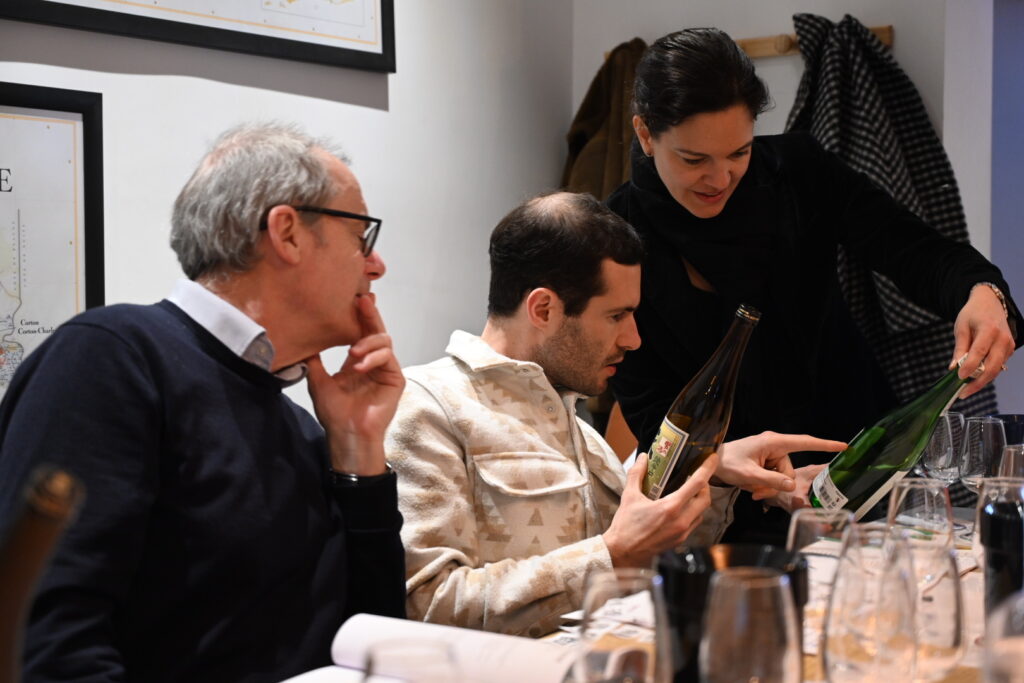
At Weeno, courses take place in small groups of up to 14 participants, ensuring a high level of interaction, exchange and individual support — or online, from the location of your choice, via the official WSET platform. Every question has its place, every profile is supported, and learning becomes a real dialogue.
The experience also relies on tasting, which sits at the heart of our pedagogy. We pay particular attention to the quality and selection of samples: wines from organic or sustainable agriculture, committed producers, and cuvées chosen for their typicity and their ability to clearly illustrate the styles being studied. In spirits, beer and sake as well, we prioritise a high-end selection that combines benchmark references with more confidential discoveries. Each product is chosen not only for its pedagogical relevance, but also for the emotion it can evoke.
This balance between rigour and pleasure also rests on the educators. At Weeno, courses are led by certified and experienced instructors who fully master the programmes and exam requirements while also knowing how to create an engaging atmosphere. Their role is not limited to transmitting content: they share a method, provide practical benchmarks, support progression and, above all, know how to bring their passion to life. Learning is always more effective when the experience itself is enjoyable.
We offer courses in Paris, Marseille and online, in order to adapt to a wide range of constraints and profiles. This flexibility goes hand in hand with a constant commitment: to provide serious and continuous support, from enrolment to the exam and through to diploma completion.
In other words, taking a WSET course with Weeno is not just about preparing for a certification.
It means entering a structured and demanding framework, benefiting from attentive support, tasting carefully selected products, and learning in an environment where precision meets pleasure.It means experiencing learning that is at once technical, sensory and deeply human.
WSET: more than a diploma, a framework for understanding the world of drinks
The WSET is not simply a well-known name in wine and spirits. It is an international awarding organisation that has, over the decades, structured a shared professional language, clear progression levels and a learning method recognised across the drinks sector. Understanding who the WSET is therefore means understanding why its name appears so often across drinks-related professions.
A WSET certification gives you far more than a line on a CV. It enables you to build solid technical knowledge, develop a structured tasting ability, gain a more refined understanding of styles and progress within a coherent educational framework. This combination is precisely why it is so widely recognised: it rests on international standards, a clear methodology and real pedagogical value.
For those who want to go further, the next step is straightforward: explore the available programmes, identify the level best suited to your profile, and then speak with our team to build a training project that is coherent, demanding and truly useful.