
Becoming a sommelier: a profession driven by passion… but also by method
When people ask how to become a sommelier, they often picture someone serving wine in a restaurant and recommending the right bottle at the right moment. That is true, but it is far from capturing the full reality of the profession.
Being a sommelier also means selecting wines, building a wine list, managing a cellar, designing food and wine pairings, advising customers, speaking with producers and conveying a culture of taste with precision. It is a profession that is at once technical, commercial, sensory and deeply human.
In other words, passion alone is not enough. It matters, of course. But it must be supported by method, training and hands-on experience.
In this article, we will look at which qualifications and training paths can help you become a sommelier, what salaries and career opportunities are possible, and why certifications such as the WSET, offered at Weeno, can play a key role in building a serious career path in wine.
1. Sommelier: what does the job really involve?
The role of a sommelier is not limited to presenting a bottle or pouring wine in the dining room. It is a much broader profession, at the crossroads of taste, service and business. The French Onisep career profile also points out that a sommelier manages the restaurant cellar, oversees orders, checks deliveries, monitors stock and advises guests in the dining room.
In practice, the sommelier’s work begins with service and guidance. They support the guest, recommend a wine suited to the meal, the budget and the occasion, and then ensure precise and polished service. This visible side of the job is important, but it is only one part of the role. Training frameworks in sommellerie also emphasise the ability to create and update a wine and beverage list, design food and beverage pairings, and present products in a relevant and compelling way.
The sommelier also works upstream, on producer selection and purchasing. They must identify bottles that match the positioning of the establishment, negotiate with suppliers, organise orders and ensure that deliveries are received properly. This requires a genuine understanding of the market, but also rigorous cellar and stock management, because mistakes in purchasing or storage can have a direct impact on profitability.
Added to this is an essential educational dimension. A good sommelier does not simply know wines; they also know how to speak about them clearly, adapt their message to the guest, explain a style, reassure, guide and sometimes even train a team. The French CS Sommellerie syllabus also underlines that the training covers sensory analysis, commercial activity, service organisation and beverage promotion.
This is also why soft skills matter just as much as technical knowledge. The job requires listening skills, memory, rigour, a real commercial instinct and the ability to create a smooth and well-judged experience for the guest. In other words, the sommelier is at once a taste specialist, a service professional and a contributor to the commercial performance of the establishment.
2. Do you need a qualification to become a sommelier?
The short answer is: not in one single mandatory way, but in practice, training matters a great deal. In France, there is no single entry route into the profession. Legally and professionally, several paths coexist. That said, the most credible career paths are generally built around three pillars: a professional qualification, hands-on experience, and additional training.
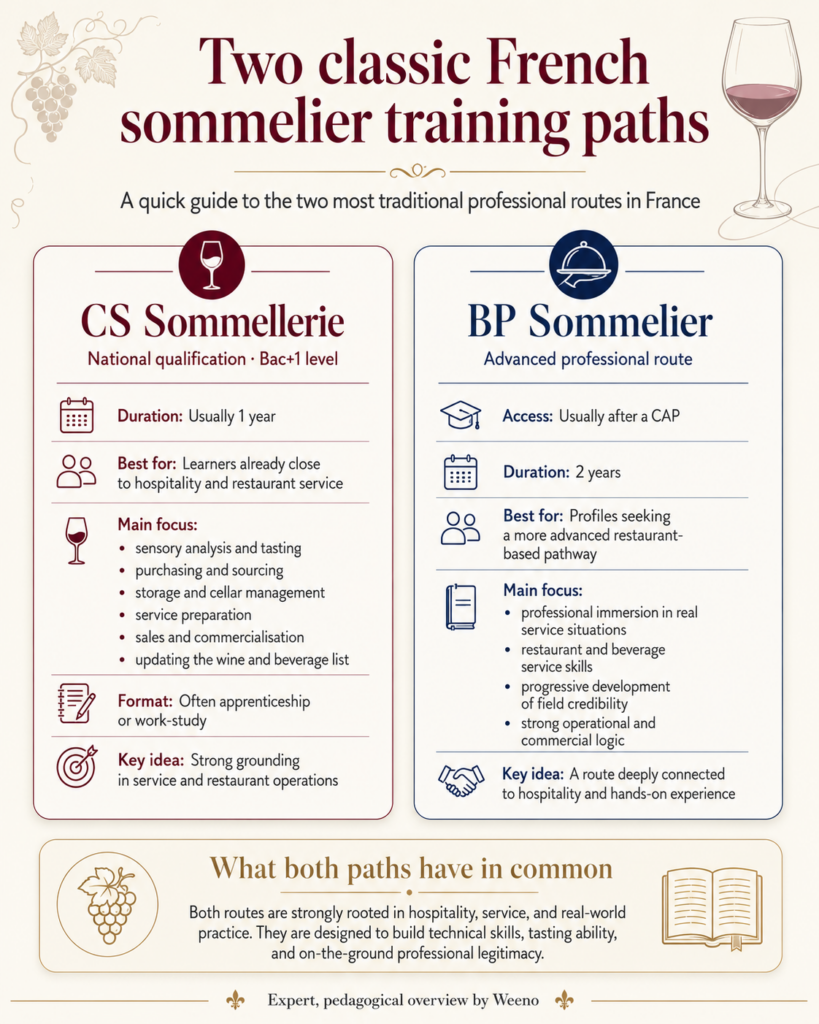
The most traditional French routes remain highly structured. In particular, it is possible to enter the profession through a CS Sommellerie completed in one year after a vocational qualification or a professional baccalauréat in hospitality, or through a BP Sommelier completed in two years after a CAP. These qualifications have the advantage of being directly rooted in the realities of service, front-of-house work and hospitality. The CS Sommellerie is indeed presented as a one-year national qualification focused on sensory analysis, food pairings, cellar management, service and commercialisation.
But these qualifications are not the only lever. It is also important to distinguish additional certifications and training programmes, which do not necessarily replace a French professional qualification, but can significantly strengthen a candidate’s credibility and skill set. This is especially true of programmes that develop analytical tasting, international wine knowledge, understanding of styles, and professional vocabulary. In a profession where the readability of skills matters a great deal, these types of training play a strategic role.
Finally, hands-on experience remains decisive. People can enter the profession through hospitality, through gradual progression within an establishment, through a serious career change, or through a more structured specialisation in wine after an initial professional path. In other words, you do not become a sommelier through a title alone, but you also do not become a lasting and credible sommelier without training, practice and method.
This is precisely why it is important to avoid creating an artificial opposition between qualification, certification and field experience. In reality, the strongest career paths often combine all three: a solid professional foundation, real service experience, and additional training capable of broadening the way a candidate reads wines and the market.
3. French qualifications… and the additional training that really makes a difference
In France, the most traditional paths into sommellerie are still strongly structured around professional qualifications rooted in hospitality. The best-known is the Certificat de spécialisation (CS) Sommellerie, a national qualification at post-baccalaureate level designed to deepen skills in tasting, purchasing organisation, storage, sales and the service of wines and other beverages. Its official framework highlights the very practical dimensions of the profession: sensory analysis, sourcing, storage, service preparation, sales, and updating the wine list.
This qualification is mainly aimed at candidates who already have some proximity to the hotel and restaurant sector. It is usually completed in one year, often through apprenticeship or work-study formats depending on the institution. This is an important point: in the French system, the logic remains closely tied to hands-on practice, service and the dining-room environment.
Another, more advanced route for some profiles is the BP Sommelier. This two-year professional qualification, accessible after a CAP, follows a strongly vocational approach. Here again, the pathway remains closely connected to hospitality, learning the profession in real working conditions, and gradually building practical legitimacy in the field.
But this is where an essential nuance needs to be introduced: a qualification alone is not always enough. It provides a foundation, a framework and recognition. Yet in a profession as dynamic and constantly evolving as sommellerie, it is often necessary to go further. Why? Because today’s sommelier must broaden their knowledge beyond wine alone, understand spirits, and sometimes beer or sake, read styles with precision, and above all develop a true tasting method and a solid professional vocabulary.
This is where additional training becomes particularly valuable. It helps make a profile more readable, broadens product culture, and gives a more rigorous structure to the understanding of styles. In this respect, internationally recognised certifications such as the WSET play a particularly relevant role. WSET presents itself as a major global provider of drinks qualifications, with progressive programmes in wine, spirits, beer and sake, followed in more than 70 countries.
In other words, French qualifications build a very useful professional foundation, especially within a hospitality-driven logic. Additional certifications, by contrast, often strengthen analytical reading, broaden drinks knowledge, and give a career path a wider, more structured and more international dimension. This is precisely what makes our WSET courses relevant as a strategic complement for a future sommelier: not as an automatic substitute for French qualifications, but as a powerful tool for gaining method, clarity and greater depth of analysis.
4. Why WSET is relevant for a sommelier career — and which level to choose
The WSET is not a sommelier qualification in the French professional sense. It does not replace a CS Sommellerie, a BP Sommelier, or real experience in front-of-house service. What it does offer, however, is a set of skills that are especially valuable for building a serious career in wine — and therefore in sommellerie.
Its main strength lies in its method. WSET teaches students how to taste analytically, understand wine styles, connect a tasting profile to its causes — climate, grape variety, viticulture, winemaking and ageing — and use a clear, structured professional vocabulary. For a future sommelier, this ability to read a wine precisely is a real asset. It helps not only with tasting, but also with explaining, advising and arguing with confidence.
Another major advantage is its international perspective. While French pathways are often closely tied to hospitality and service, WSET offers a broader reading of wine regions, markets and the major categories of wines from around the world. This is particularly useful for people who want to work in international environments, in establishments serving an international clientele, or more generally in a modern form of sommellerie where wine culture extends far beyond a purely local frame of reference.
This is also what makes WSET relevant for very different kinds of profiles:
- motivated beginners who want to build solid foundations quickly;
- front-of-house professionals who want to gain precision and credibility;
- career changers who need a structured and readable framework for progression;
- and internationally oriented profiles for whom WSET recognition is a genuine advantage.
That leads to a practical question…
Which WSET level should you choose if you want to become a sommelier?
WSET Level 1 is a first step in. It introduces wine in a structured way, within a simple and clear framework. It is a good starting point for someone who is completely new to the subject, or for a younger candidate who wants to begin laying proper foundations.
WSET Level 2 is often the key stage. It provides a much stronger base for understanding the major styles, the main regions, the key grape varieties and the general logic of tasting. For many profiles, it is already an excellent foundation for professionalisation.
WSET Level 3 becomes particularly relevant for a more serious sommellerie project. It develops a more precise understanding of the factors influencing style and quality, a more rigorous tasting method and a much more advanced analytical capacity. For a professional already in the trade, a young hospitality worker wanting to move up, or a committed enthusiast in the middle of a serious career change, this is often the level that truly deepens the way wine is read.
In practical terms, the recommendation is often the following:
- if you are starting from scratch: Level 1 or 2, depending on your confidence and background;
- if you are young and already working in hospitality or at the start of your career: Level 2 is often the most relevant;
- if you are already in the industry or seriously considering a career change: Level 3 is often the level that brings real professional value.
This is precisely why WSET courses have a natural place in a path toward sommellerie. They do not simply teach people how to recognise wines: they teach them how to read, understand and talk about wine with method. And that is exactly what makes the difference in the profession.
5. What salary can a sommelier expect?
Talking about a sommelier’s salary requires some caution. There is no single figure, because pay varies significantly depending on experience, type of establishment, location and level of responsibility. A sommelier working in a bistro, brasserie, luxury hotel or fine dining restaurant will not be paid on the same scale. In the same way, a junior profile will not earn the same as a head sommelier responsible for a substantial cellar, strategic purchasing and team management.
Recent salary data for the profession is often aggregated or close to the broader role of sommelier-wine merchant, which means it should be read with nuance. Hellowork, for example, indicates a median gross salary of around €26,000 per year for a “sommelier-caviste”, with notable regional differences. This gives a useful order of magnitude, but it does not fully reflect the real diversity of situations within hospitality and restaurant service.
In practice, it is more useful to think in terms of broad professional levels:
- a junior sommelier often starts on a salary still close to the standards of skilled hospitality roles, especially while learning the profession and gaining autonomy;
- a more experienced sommelier can progress thanks to experience, advisory skills, purchasing knowledge and the quality of their service;
- a head sommelier, or someone working in a high-end establishment, a hotel group or a highly reputed house, can reach substantially higher levels of pay, particularly when managerial responsibilities, a major cellar, demanding clientele and a strong commercial dimension are involved.
The type of establishment therefore plays a major role. The more high-end, international or wine-focused the environment is, the more room there is for salary progression. Location also matters: large cities, certain tourist areas and prestige venues often offer higher levels of pay, although these usually come with greater expectations as well.In other words, the real answer to the question “how much does a sommelier earn?” is this: it depends on the stage of the career and the professional setting. What is certain, however, is that salary progression rarely depends on seniority alone. It also depends on the credibility of the profile, technical level, ability to manage a cellar, advise guests, build a coherent wine list and bring commercial value to the establishment.
6. The right path: qualification, field experience and certification
There is no single path to becoming a sommelier. In fact, this is one of the most important realities of the profession: some people come from hospitality, others from a more academic background, and others from a gradual career change. What matters, in the end, is not having followed one fixed route, but building a coherent path.
In practice, the right path often combines several dimensions:
- a professional qualification or an initial solid experience in hospitality;
- real hands-on experience, in contact with service, the cellar and guests;
- a logic of continuous training, to broaden knowledge and refine the reading of wines;
- and a readable certification such as the WSET, which brings method, structure and additional recognition.
This is also what makes progression credible. You do not become a sommelier all at once, nor through a qualification alone, nor through passion alone. Growth in the profession is built over time, through accumulated experience, repeated tasting, learning service and the ability to turn knowledge into real skill.
In other words, the best path is not necessarily the most linear one. It is the one that allows you, step by step, to connect knowledge, field experience and professional credibility.

Becoming a sommelier means building expertise, not just earning a title
Becoming a sommelier is not simply about stepping into a role or obtaining a qualification. It means building, over time, a complete expertise: understanding wines, knowing how to taste them, talk about them, serve them, buy them and present them effectively in a professional setting.
As we have seen, several paths are possible. French qualifications such as the CS Sommellerie or the BP Sommelier remain strong foundations, particularly within a hospitality-driven career path. But they are often even more effective when combined with hands-on experience, continuous training and certifications that broaden the way wines and beverages are understood.
This is where the WSET naturally finds its place. While it is not a sommelier qualification in the French professional sense, it provides skills that are highly relevant to the profession: analytical tasting, understanding of styles, professional vocabulary and an international perspective. Level 2 offers a very strong foundation, while Level 3 is especially relevant for a serious professional project, thanks to its advanced focus on the factors influencing style, quality and tasting.
In the end, the right path is rarely a single one. It often combines training, experience, method and continuous progression. It is this patient construction that transforms a passion for wine into real professional legitimacy.
If you would like to go further, the simplest next step is to explore our WSET courses, identify the level best suited to your profile, and speak with our team to build a pathway that is coherent with your project.