Cognac and brandy: closely related, but not the same
All Cognac belongs to the wider family of wine-based spirits. But not every wine spirit — and certainly not every brandy — can be called Cognac.
The main difference lies in origin and production regulations. Cognac is a protected appellation, produced within a defined geographical area and according to strict rules covering grape varieties, distillation and ageing.
Brandy, on the other hand, refers to a much broader category of spirits made from wine and produced in many regions around the world. In Europe, the term is also governed by its own legal definition.
Behind these two names are therefore very different styles, production methods and sensory profiles.
In this article, we explore the history of Cognac and brandy, how they are made, the role of grapes, distillation and oak, the VS, VSOP and XO age categories, major brandy-producing regions around the world, and how to taste and use these spirits in cocktails — just as we do during our WSET Spirits courses.
1. Cognac vs brandy: what is the real difference?
The words Cognac and brandy are sometimes used as though they were interchangeable.
They belong to the same broad family, but they do not mean exactly the same thing.
What is brandy?
In broad terms, brandy is a spirit made from wine or wine spirit.
In the European Union, however, the designation brandy or Weinbrand has a specific legal definition. Among other requirements, it must be produced from wine spirit and matured in oak for at least one year in large wooden vessels, or for at least six months in oak casks with a capacity of less than 1,000 litres.
Its minimum alcoholic strength is 36% ABV.
What is Cognac?
Cognac goes much further in terms of geographical origin and production rules.
It must be produced within a clearly defined area, using authorised grape varieties, undergo double Charentais distillation, and then mature for at least two years in oak.
The appellation therefore regulates the entire process, from the vineyard through to maturation.
What makes Cognac unique is not simply its raw material. It is the combination of origin, grape varieties, distillation method, ageing and regulation.
Key takeaway: Cognac is not a generic term for premium brandy. It is a protected appellation with its own specific production rules.

2. The history of Cognac: from trading wine to a global spirit
The history of Cognac begins with a very practical challenge: how to make wine easier to transport and more stable over long journeys.
From the 16th century onwards, Dutch merchants trading through the ports of the Charente region began distilling local wines, which were relatively low in alcohol and could be fragile during long sea voyages.
They called the resulting product brandwijn, literally “burnt wine” — the origin of the word brandy.
During the 17th century, producers in the region gradually refined the process through the development of double distillation.
More concentrated and more stable, the resulting spirit was better suited to international trade.
Ageing emerged almost as a secondary discovery.
As spirits spent longer periods in oak barrels during storage and transport, producers noticed that they gained colour, texture and aromatic complexity.
Oak was no longer simply a container: it became an important part of the production process.
From the 17th and 18th centuries onwards, Cognac trading houses multiplied. They bought, matured, blended and sold eaux-de-vie, gradually shaping both the style and international reputation of Cognac.
That export focus remains central today: in 2025, almost 97% of Cognac was consumed outside France, across nearly 139 countries.
Cognac has therefore been deeply connected to international trade since its earliest history.

3. How is Cognac made?
Cognac production follows a highly regulated series of steps.
More importantly, every decision — from the grape through to the final blend — can influence the style of the finished spirit.
Step 1: White grapes suited to distillation
The Cognac vineyards are overwhelmingly planted with Ugni Blanc, which represents more than 98% of the vineyard area.
This grape variety is particularly well suited to distillation because it produces wines with high acidity, relatively low alcohol and a fairly neutral aromatic profile.
The aim is not to create a highly expressive white wine for immediate drinking.
Instead, producers need a fresh, stable base wine capable of producing a precise and balanced spirit after distillation.
Step 2: Producing the base wine
After harvest, the grapes are pressed and fermented.
The resulting wine is usually light-bodied, acidic and relatively low in alcohol.
It is not intended to be enjoyed as a finished wine: its purpose is to be distilled soon after fermentation.
Step 3: Double Charentais distillation
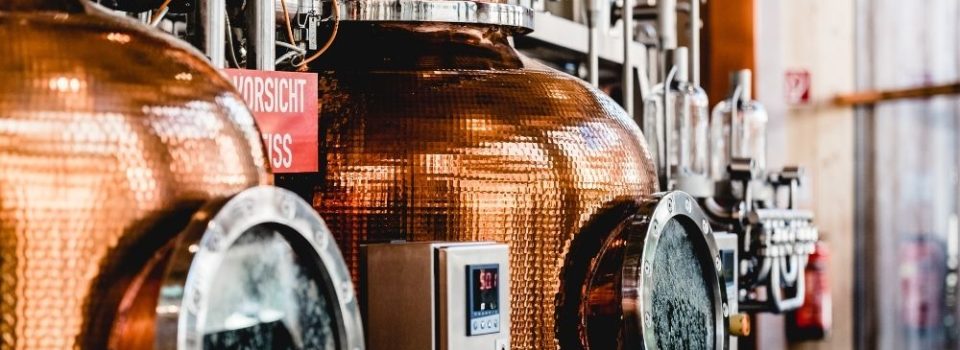
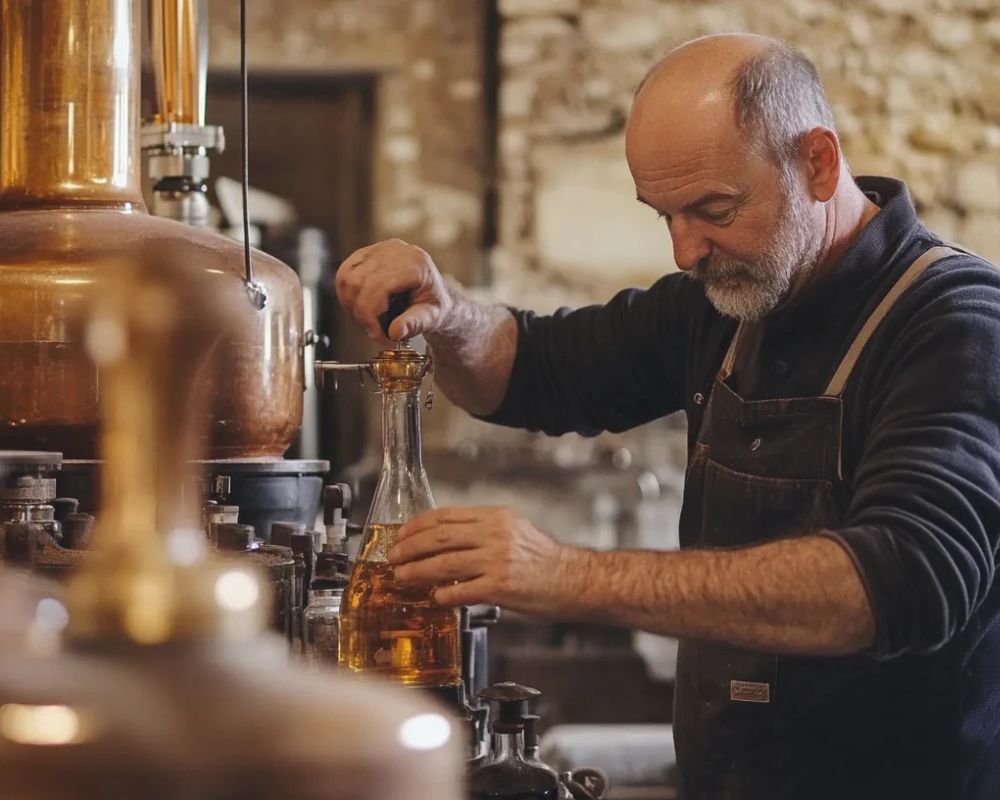
Cognac is distilled twice in a traditional copper Charentais pot still.
The first distillation transforms the wine into a low-strength distillate known as the brouillis.
This is then distilled again during the bonne chauffe, or second distillation.
At this stage, the distiller makes a series of cuts to isolate the heart of the distillation, the fraction intended to become Cognac.
This is a critical stage.
Temperature, cut points and the way the still is operated can all have a major influence on the final aromatic profile.
Step 4: Oak ageing
The spirit is then matured in oak barrels.
During ageing, it extracts compounds from the wood, undergoes gradual oxidation and develops increasingly complex aromas such as vanilla, spices, dried fruit, nuts and woody notes.
Some of the liquid naturally evaporates over time.
This loss is famously known as the “angel’s share”.
Step 5: Blending and reduction
The final stage often involves blending.
The cellar master may combine eaux-de-vie of different ages, styles and sometimes different crus in order to create a balanced and consistent house style.
Blending is not compulsory, however.
Cognac may then be gradually reduced with water to reach the desired alcoholic strength before bottling.
It is this combination of raw material, distillation, time, oak and blending that creates the complexity of Cognac.
4. The six Cognac crus: why does origin matter?
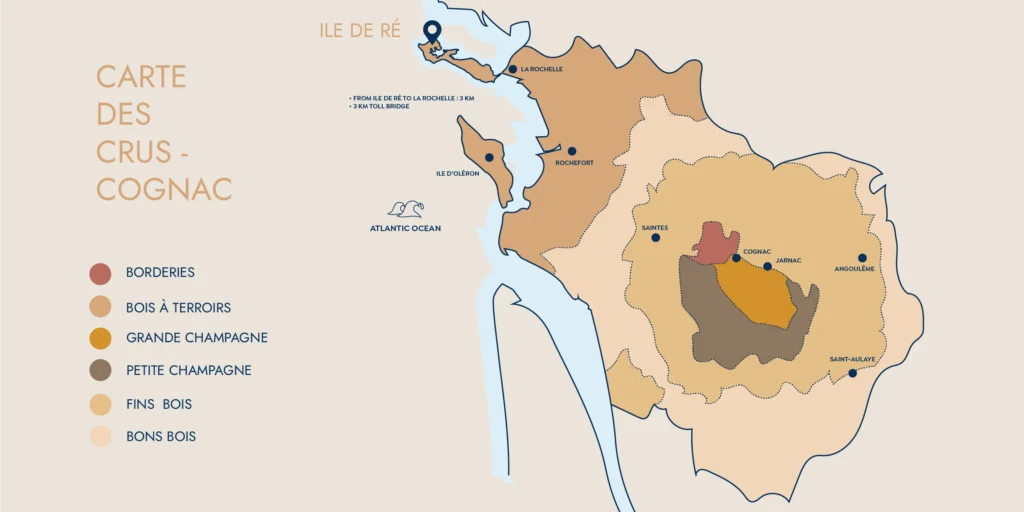
The Cognac vineyard is officially divided into six crus:
Grande Champagne, Petite Champagne, Borderies, Fins Bois, Bons Bois and Bois Ordinaires.
These crus should not be understood as a simple quality hierarchy.
Instead, they are geographical areas with different soils and climatic conditions, which influence the base wines and, later, the character of the distilled and matured eaux-de-vie.
Grande Champagne and Petite Champagne are particularly known for their highly calcareous soils, which can retain water while still providing good drainage.
They generally produce fine, structured eaux-de-vie that are particularly well suited to long ageing.
The smaller Borderies cru can produce rounder, more floral styles, while Fins Bois, Bons Bois and Bois Ordinaires cover more varied conditions, sometimes with a stronger maritime influence.
One important point to remember:
Fine Champagne and Grande Champagne are not the same thing.
Grande Champagne is one of the six individual crus.
Fine Champagne, by contrast, is a designation used for a blend of eaux-de-vie exclusively from Grande Champagne and Petite Champagne, with at least 50% coming from Grande Champagne.
Origin therefore does not determine Cognac quality on its own, but it is one of the first building blocks of style.
5. VS, VSOP, XO and XXO: understanding Cognac age statements
The terms VS, VSOP and XO are not arbitrary style categories.
They indicate the minimum age of the eaux-de-vie used in the Cognac blend.
One principle is essential:
the youngest eau-de-vie in the blend determines the age category shown on the bottle.
What do VS, VSOP, Napoléon, XO and XXO mean?
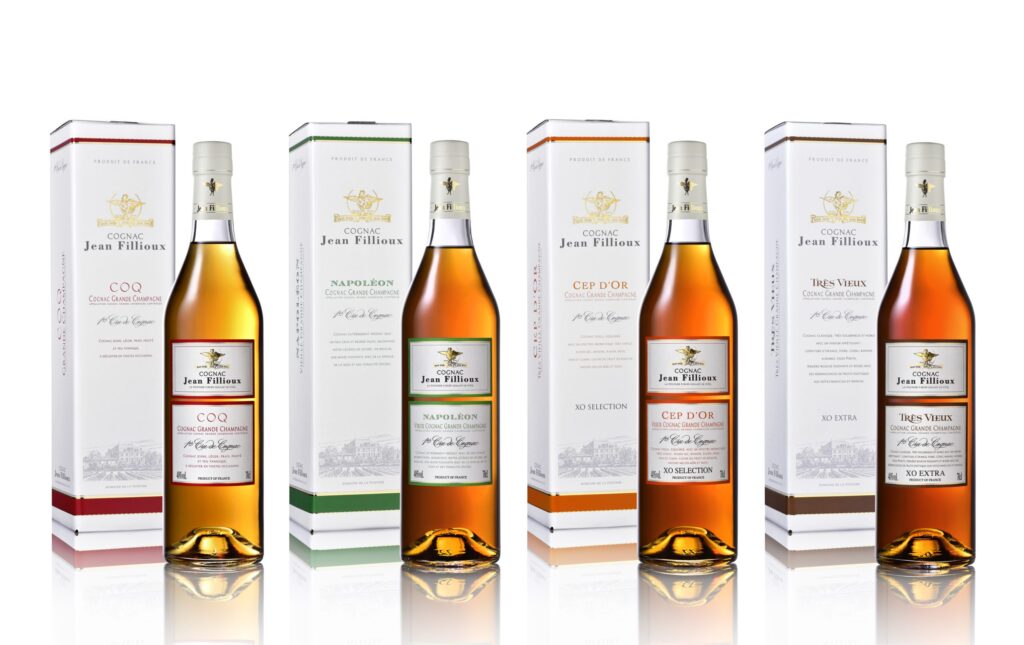
A VS — Very Special must contain eaux-de-vie whose youngest component has spent at least 2 years ageing in wood.
For VSOP — Very Superior Old Pale, the minimum is 4 years.
The Napoléon designation requires at least 6 years of ageing.
An XO — Extra Old must contain eaux-de-vie that are at least 10 years old.
Finally, XXO — Extra Extra Old requires a minimum age of 14 years.
| Category | VS | VSOP | Napoléon | XO | XXO |
| Minimum ageing | 2 years | 4 years | 6 years | 10 years | 14 years |
This does not mean that an XO contains only ten-year-old eaux-de-vie.
The blend may include much older components: only the youngest eau-de-vie determines the age designation.
Another important difference from wine is that Cognac stops ageing once it is bottled.
The major transformations associated with oak and oxygen occur while the spirit is in barrel.
A bottle of VSOP kept in a cellar for twenty years therefore does not become an XO.
And most importantly, age and quality are not synonymous.
Longer ageing changes the style, but it does not automatically guarantee a better Cognac.
6. Major wine spirits around the world
Cognac is only one expression within the much wider world of spirits made from wine.
Similar raw materials can produce very different spirits depending on geographical origin, distillation method, maturation and regulation.
In France, Armagnac is the other major reference.
Its production traditionally relies on a different distillation system from Cognac, often using continuous distillation in an Armagnac still.
This can contribute to styles that may appear more rustic, spicy or expressive in their youth.
In Spain, Brandy de Jerez owes much of its identity to maturation within the Jerez region, often using the solera and criaderas system.
Casks that previously held Sherry can contribute aromas of dried fruit, caramel, nuts and spices.
South Africa also has a long tradition of quality brandy production, with styles ranging from fruity, approachable expressions to complex spirits matured for long periods.
In the United States, particularly California, producers work with a wide variety of grape varieties and production methods, resulting in a broad range of styles.
Finally, Pisco, produced in Peru and Chile, also belongs to the wider family of grape-based spirits.
But it should not simply be considered an aged brandy: its production rules, grape varieties and approach to maturation are specific, and styles vary considerably between the two countries.
The key point is simple:
the same raw material does not necessarily produce the same spirit.
Origin, distillation and maturation shape identity just as much as the grape itself.
7. Why can two Cognacs taste completely different?
Two Cognacs may come from the same appellation and still offer radically different sensory profiles.
This is where analytical tasting becomes particularly interesting.
The final style depends on a chain of decisions and factors:
grape variety + cru + fermentation + distillation + cuts + lees or no lees + type of oak + ageing time + cellar conditions + blending.
Every stage leaves its mark.
A finer distillate produced with precise cuts and matured for a long time in seasoned oak will not taste the same as a more structured eau-de-vie produced with greater extract and a stronger oak influence.
Over time, the aromatic profile also evolves.
A Cognac may move from fresh fruit and floral notes towards dried or candied fruit, followed by more complex aromas of vanilla, spices, nuts, tobacco and leather.
Very old eaux-de-vie may also develop characteristics sometimes described as rancio.
But one idea is essential:
older does not automatically mean better.
A young, lively and fruity VS may be perfectly suited to a highball or cocktail.
An XO, by contrast, may aim for greater complexity, depth and length.
The real question is therefore not simply how old the Cognac is.
It is whether its style, intended use and overall balance work together successfully.
8. How to taste Cognac or brandy like a professional
Tasting Cognac or brandy professionally means moving beyond a simple “I like it” or “I don’t like it” reaction.
The aim is to understand how the spirit is structured and balanced.
Appearance
Start with colour and intensity:
pale gold, amber, mahogany…
But colour alone cannot tell you the exact age of a Cognac.
The type of cask, its previous use and the producer’s choices can also affect appearance.
Nose
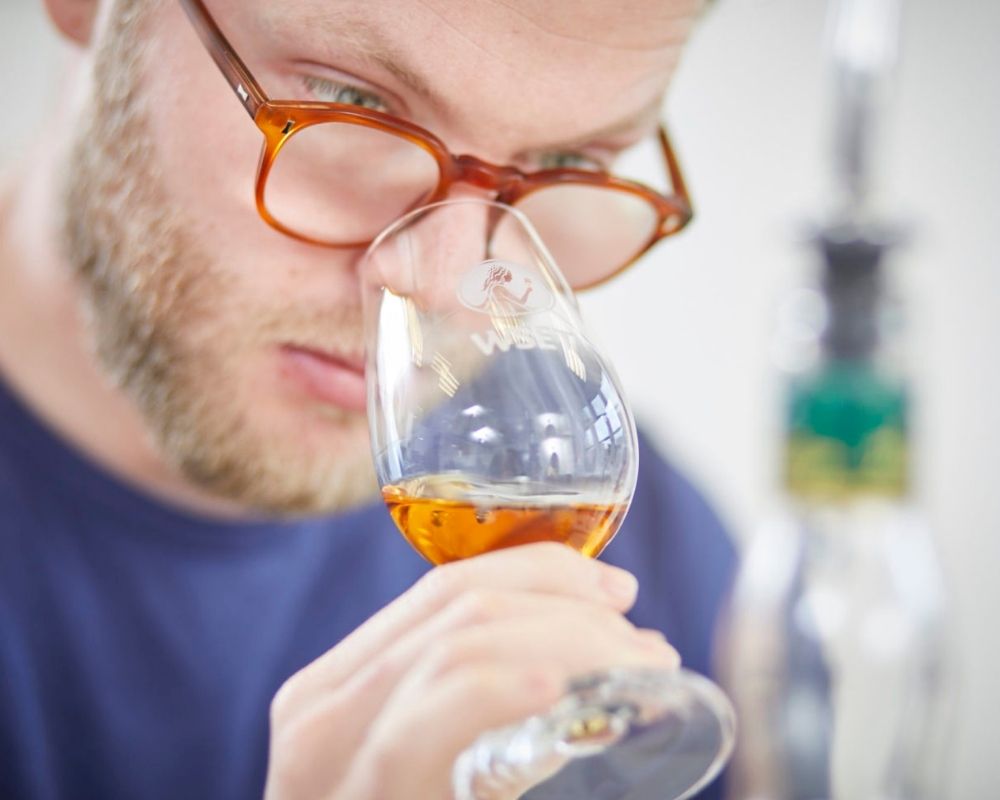
Bring the glass gradually towards your nose rather than placing it directly under your nostrils, especially with higher-strength spirits.
Start by identifying broad aromatic families:
fresh or dried fruit, flowers, spices, vanilla, oak, nuts, tobacco and tertiary or mature aromas.
Then ask whether the nose is precise, complex and harmonious.
Palate
On the palate, assess separately:
alcohol, sweetness, body, flavour intensity, complexity, length and balance.
A small addition of water can sometimes help release additional aromas, particularly in more concentrated expressions.
Glassware also matters.
A glass that narrows towards the rim helps concentrate aromas and supports a more analytical tasting approach.
Assessing quality
Using a framework similar to the WSET Systematic Approach to Tasting, quality is not simply about sweetness or age.
Instead, we consider elements such as: balance, length, intensity and complexity.
An older Cognac may be fascinating, but a younger spirit can also be remarkably precise, balanced and completely appropriate for its intended style.
Cognac in our WSET Spirits courses
| Level | Focus | Tastings | Format | Funding |
| Level 1 | Foundations | 15 tastings in person / 11 online | Paris, Marseille, online | CPF funding via CLOE or LTE |
| Level 2 | Categories and production | 45 tastings in person / 32 online | Paris, Marseille, online | CPF funding via CLOE or LTE |
| Level 3 | Advanced analysis | 65 tastings in person / 32 online | Paris, online in English only | CPF funding via CLOE or LTE |
9. Cognac with food and in cocktails: far beyond the after-dinner drink
Cognac is not condemned to a leather armchair after dinner.
Around the world, it is widely enjoyed in cocktails: according to the BNIC, approximately 80% of Cognac is consumed in mixed drinks.
That helps explain the continued popularity of classics such as the Sidecar, Sazerac and Cognac Highball, where the style of the Cognac matters just as much as the recipe itself.
A younger Cognac with a lively, fruity profile can bring freshness and structure to a cocktail.
Older, more complex expressions may be better suited to sipping neat or pairing with food.
At the table, the aim is to create a balance between aromatic intensity, texture, alcohol and persistence.
A few pairings work particularly well:
- Cognac + dark chocolate: intensity and bitterness complement one another.
- Cognac + mature cheese: concentrated flavours can stand up to powerful cheeses.
- Cognac + duck or roasted meat: spice and oak notes complement roasted flavours.
- Cognac + dried fruit: a natural continuation of mature aromatic characters.
- Cognac + sushi or smoked fish: a more unexpected pairing, but one that can work with finer, more precise styles.
There is no single fixed rule for pairing Cognac.
It is ultimately a question of style and balance.
Understanding Cognac means understanding spirits
Understanding Cognac is not simply about knowing the difference between VS, VSOP and XO.
It is about understanding how a relatively neutral white wine can become, through distillation, oak, time and blending, a spirit of remarkable complexity.
That is precisely why Cognac is so interesting to study.
It allows us to connect raw material, production method, maturation, style and quality in a very concrete way — the same logic that applies across many other spirit categories.
In Weeno’s WSET Spirits courses, Cognac is studied alongside major categories including Armagnac, whisky, rum, tequila, mezcal, gin and vodka.
The objective is to move beyond definitions and understand why a spirit tastes the way it does, and how to assess its quality using a structured methodology such as WSET.